
Optimizing Wall Thickness
Design Choices to Reduce Thermoforming Costs
In thermoforming, wall thickness is one of the most critical cost drivers. Even small inefficiencies in thickness distribution can significantly increase material usage, cycle time, and overall production cost.
At HIPLEX Technologies, we focus on precision-engineered thickness optimization—ensuring every micron of material contributes to performance, not waste.
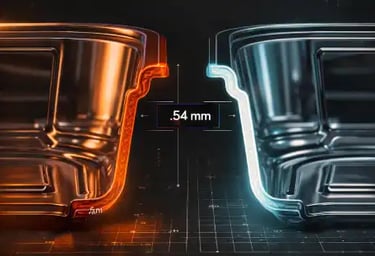
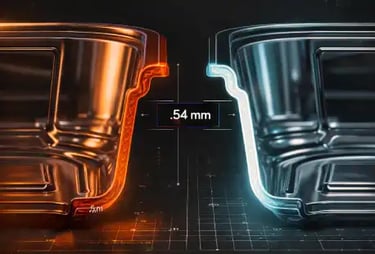
Optimized part geometry and radii play a critical role in achieving uniform wall thickness.
In high-volume production, multi-cavity tooling design must ensure consistent thickness across all parts.
WHY WALL THICKNESS MATTERS
1. Direct Material Cost Impact
Material accounts for 60–80% of total product cost
Excess thickness = direct cost increase
Uniform optimization = immediate savings
2. Structural Integrity vs Overdesign
Over-thick designs don’t always mean stronger products
Smart distribution ensures:
Strength where needed
Reduction where not required
3. Cycle Time Efficiency
Thicker parts require:
More heating time
Longer cooling cycles
ptimized thickness = faster production
COMMON DESIGN MISTAKES
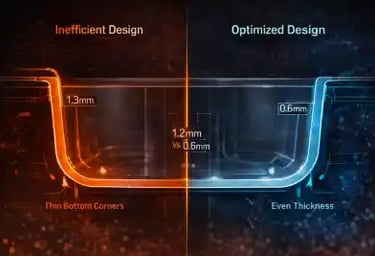
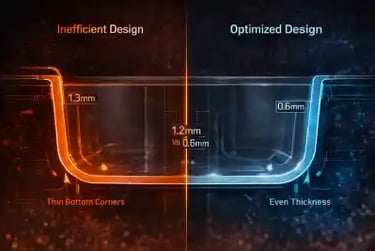
Uneven Wall Distribution
Thick base + thin side walls
Leads to weak points and material waste
Over-Engineering
Adding thickness “for safety”
Increases cost without functional benefit
Ignoring Material Flow
Poor design leads to:
Thinning in corners
Stress concentration
HIPLEX APPROACH: ENGINEERED OPTIMIZATION
Uniform Thickness Strategy
Maintain consistent wall distribution across geometry
Avoid unnecessary mass concentration
Consistent thickness helps in reducing secondary operations such as trimming and rework.
Functional Thickness Design
Reinforce only:
Load-bearing areas
Stack zones
Edge structures
Material Intelligence
Use PET behavior knowledge:
Stretch ratios
Heat zones
Flow characteristics
TECHNICAL DESIGN PRINCIPLES
Ideal Thickness Range
Depends on application, but:
Thin enough for cost efficiency
Thick enough for structural performance
Thickness Control Zones
Area Design Focus
Base --------------------------------- Load support
Side walls -------------------------- Uniform thinning control
Corners ----------------------------- Radius-driven distribution
Rim / flange------------------------ Strength + stacking
Use of Radii
Sharp corners = thinning risk
Smooth radii = better material distribution
Proper draft angles also support uniform material distribution and prevent thinning at vertical walls.
Plug Assist Optimization
Controls material stretch
Ensures even thickness in deep draws
OPTIMIZING WALL THICKNESS
BENEFITS OF OPTIMIZATION
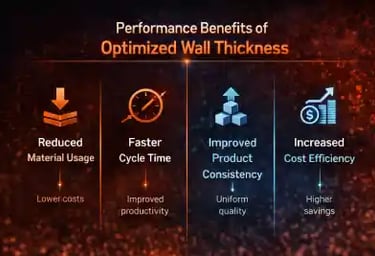
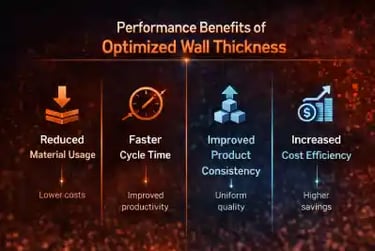
Reduced Material Consumption
Up to 20–40% savings depending on design
Improved Product Consistency
Uniform thickness = predictable performance
Faster Production
Reduced heating & cooling cycles
Lower Rejection Rates
Better structural integrity
INDUSTRY APPLICATIONS
Food packaging trays
PET cups and containers
Blister packs
Industrial packaging
HIPLEX VALUE PROPOSITION
At HIPLEX, we don’t just manufacture—we engineer efficiency.
We combine:
Advanced tooling design
Material science expertise
Precision thermoforming
To deliver:
Stronger products with less material
Lower cost without compromise
CONCLUSION
Optimizing wall thickness is not about making products thinner—
It’s about making them smarter.
With the right design approach, manufacturers can achieve:
Cost reduction
Performance reliability
Sustainable material usage
Explore Complete Design Guidelines
Explore our complete Thermoforming Design Guidelines to understand how geometry, tooling, and process optimization work together to deliver consistent, high-quality production.
HIPLEX TECHNOLOGIES
9884044670
© 2026 Hiplex Technologies. All rights reserved.
CONTACT
9884077280
VISIT
LINKS
No.19A , Mettupalayam, Kumili, Kannivakkam, (P.O.), Vandalur (T.K.), Chengalpattu District - 603202.